


Ford F-150 vs. Toyota Tundra: Two Icons Of The Pickup Segment
In the world of full-size trucks, few rivalries carry as much weight as the Ford F-150 vs. Toyota Tundra. Both trucks are engineered for drivers who balance hard work with weekend adventure, whether that means hauling equipment to a job site, loading up for a family road trip, or simply enjoying the confidence that comes with owning a capable full-size pickup truck. In this Ford F-150 vs. Toyota Tundra comparison from Crossroads Ford of Southern Pines, each model brings a distinct personality to the pickup segment. The Ford F-150 continues its legacy as America’s best-selling truck by offering unmatched versatility, a wide range of engine options, and thoughtful technology designed around real truck buyers. The Toyota Tundra counters with bold styling, a standard twin-turbo V6 engine, and a strong reputation for durability.
Still, when everyday usability, flexibility, and long-term value are considered together, many drivers find the Ford F-150 vs. Toyota Tundra discussion naturally leans toward Ford. If your lifestyle demands a truck that adapts seamlessly across different locations and tasks, a visit to Crossroads Ford of Southern Pines for a test drive is the perfect way to experience how the Ford F-150 fits into your daily routine.
Engine Strength, Exterior Presence, and Confident Capability
Performance is often the deciding factor when comparing full-size trucks, and a closer look at the Ford F-150 vs. Toyota Tundra reveals meaningful differences in engine power and overall capability. The Ford F-150 offers one of the most diverse powertrain lineups in the segment, including multiple V6 and V8 engine configurations, and an advanced hybrid powertrain. These engine options are all paired with an automatic 10-speed transmission, giving drivers flexibility whether they prioritize fuel efficiency, payload capabilities, or raw strength. Depending on the Ford F-150 trim, available engine specs can reach as much as 720 horsepower and 640 lb.-ft. of torque. By contrast, the Toyota Tundra relies on a standard 3.4L i-FORCE Twin-Turbo V6 engine producing 358 horsepower and 406 lb.-ft. of torque, with the available i-FORCE MAX hybrid system increasing output to 437 horsepower, which is slightly over the Ford F-150 hybrid’s 430 horsepower. While the Toyota Tundra hybrid figures are impressive on paper, the Ford F-150 hybrid vs. Toyota Tundra hybrid conversation often favors Ford due to its seamless integration into daily work and towing scenarios.
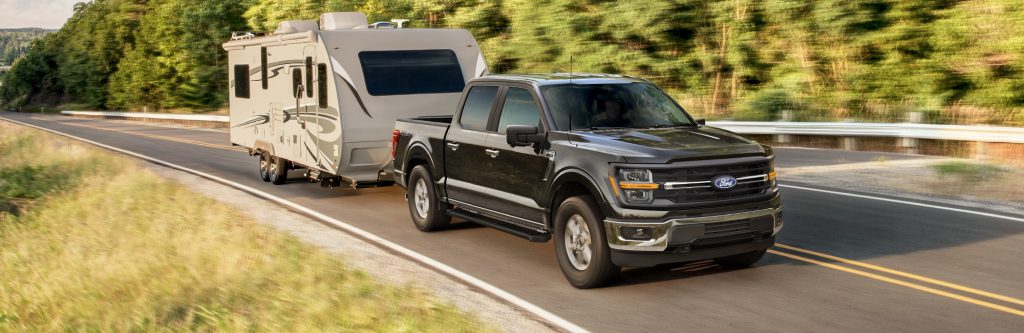
When it comes to hard numbers, the Ford F-150 stands tall with a maximum towing capacity of up to 13,500 lbs. and a maximum payload capacity of 2,440 lbs. when properly equipped. The Toyota Tundra towing capacity tops out at 12,000 lbs., which is competitive, yet the Toyota Tundra vs. Ford F-150 towing capacity discussion still highlights Ford’s clear advantage when it comes to heavy loads. Off-road capability also separates these trucks in the Ford F-150 vs. Toyota Tundra debate. The Toyota Tundra offers available Crawl Control, Multi-Terrain Select, and TRD Off-Road enhancements, making it well-suited for trail exploration. However, the Ford F-150 counters with selectable drive modes, available Rock Crawl functionality, and specialized trims like the Ford F-150 Raptor® that elevate off-road confidence even further. Exterior styling reinforces this capability-focused identity, with the Ford F-150 showcasing bold LED lighting, rugged body styles, and purposeful design cues that communicate strength without excess. While the Toyota Tundra’s aggressive stance appeals to many, the Ford F-150 balances modern refinement with unmistakable work truck toughness, enhancing ride quality and long-term usability.
Interior Comfort, Technology, and Safety Confidence
Inside the cabin, the Ford F-150 vs. Toyota Tundra comparison becomes a story of functionality versus flair. The Toyota Tundra interior emphasizes bold design and premium materials, highlighted by an available 14-in. touchscreen and a 12.3-in. digital gauge cluster, and Toyota Safety Sense™ technology for reassurance with a comprehensive suite of safety features. The Ford F-150, however, approaches interior design with productivity and comfort in mind. A standard 12-in. touchscreen and connectivity powered by SYNC® 4 delivers intuitive infotainment displays, while the digital instrument cluster keeps key data front and center. Unique features like the available Interior Work Surface transform the cabin into a mobile office, a benefit many truck buyers appreciate during long days on the job site.
Seating capacity and interior comfort are equally important, and the Ford F-150 offers generous rear seat space, supportive front seats, and durable materials designed for years of use. While the Toyota Tundra provides a comfortable environment, Ford’s attention to small details, like smart storage solutions and an adaptable center console, enhances everyday convenience. Safety technology further strengthens Ford’s position in the Ford F-150 vs. Toyota Tundra reliability conversation. Driver assistance features such as Adaptive Cruise Control, Automatic Emergency Braking, and available Pro Trailer Backup Assist™ add layers of confidence when towing or navigating busy roads. The Toyota Tundra’s standard safety features are comprehensive, yet Ford’s trailering-focused innovations often resonate more strongly with drivers who regularly haul equipment or trailers. For those evaluating the Ford F-150 vs. Toyota Tundra for which is better for long-term ownership, Ford’s blend of technology, safety, and practicality consistently delivers peace of mind.
Why the Ford F-150 Continues to Lead the Segment
After taking a closer look at performance, capability, and interior design, the Ford F-150 vs. Toyota Tundra conversation becomes clearer. The Toyota Tundra brings strong engine output, modern technology, and respectable towing figures, making it a capable contender in the pickup segment. Yet the Ford F-150 offers a broader lineup, more engine configurations, higher towing and payload ratings, and thoughtful features that support both work and recreation. Even in areas where the Toyota Tundra presents competitive strengths, the Ford F-150 responds with greater flexibility and a driving experience shaped by decades of leadership. As America’s best-selling truck, the Ford F-150 continues to evolve without losing sight of what matters most to drivers.
For those seeking a pickup that adapts effortlessly to changing needs, the Ford F-150 stands as the smarter, more versatile choice. We invite you to visit Crossroads Ford of Southern Pines, explore available trims, and experience firsthand why the Ford F-150 remains the benchmark in the Ford F-150 vs. Toyota Tundra rivalry.

