


Ford Explorer Or Toyota Highlander? Bold Family Capability With Two Distinct Personalities
When shoppers begin comparing top contenders in the midsize SUV segment, the conversation often centers on versatility, confidence, and everyday livability. In this detailed look at the Ford Explorer vs. Toyota Highlander, both models step forward as family-focused SUVs designed to balance comfort with capability. The Ford Explorer leans into a more performance-driven personality with rear-wheel drive architecture and muscular powertrain options, while the Toyota Highlander emphasizes refined road manners and thoughtful interior design. Whether you’re navigating school drop-offs, weekend sports tournaments, or long highway vacations across different locations, each SUV brings its own strengths to the table. Still, for drivers who want athletic confidence paired with adaptable utility, the Ford Explorer stands out as a compelling choice. This Ford Explorer vs. Toyota Highlander comparison is designed to help you decide which SUV best fits your lifestyle, and a visit to Crossroads Ford of Southern Pines makes it easy to experience that difference firsthand with a test drive tailored to your needs. From first impressions to long-term peace of mind, the Ford Explorer vs. Toyota Highlander discussion starts with how each model supports modern family life.
Powertrain Confidence, Styling Presence, and Everyday Capability
A closer look at performance highlights meaningful distinctions in Ford Explorer vs. Toyota Highlander specs. The Ford Explorer offers a standard 2.3L EcoBoost® inline-4 engine producing 300 horsepower and 310 lb.-ft. of torque, already surpassing expectations in this segment. For drivers seeking more spirited acceleration, the available 3.0L EcoBoost® V6 delivers up to 400 horsepower and 415 lb.-ft. of torque, giving the Ford Explorer a clear advantage in power delivery and confident passing.
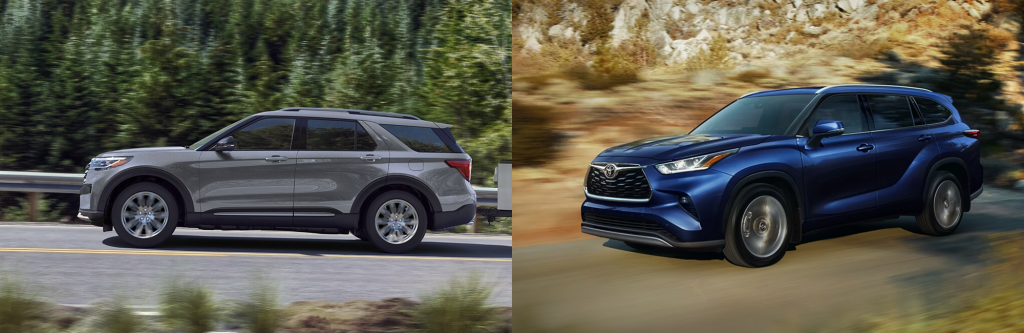
By comparison, the Toyota Highlander features a 2.4L turbocharged four-cylinder engine with 265 horsepower and 310 lb.-ft. of torque. While the numbers are respectable, the Ford Explorer’s stronger output reinforces its more athletic driving experience. Both SUVs feature selectable drive modes focused on efficiency and traction, yet the Ford Explorer’s rear-wheel drive foundation—along with available Intelligent 4WD—provides a more balanced feel under load. Exterior styling further separates the two in this Ford Explorer vs. Toyota Highlander matchup, with the Ford Explorer showcasing sculpted body lines, bold LED lighting, and a confident stance that reflects its performance-oriented engineering. Fuel efficiency considerations matter, but many drivers find that the Ford Explorer’s blend of power and control delivers a rewarding balance without compromise. Highway commutes are optimized with an EPA estimation up to 29 MPG, while the Toyota Highlander falls short at 28 MPG.*
Interior Design, Technology, and Driver-Focused Safety
Inside the cabin, both SUVs aim to deliver comfort and connectivity, yet the Ford Explorer continues to distinguish itself in the Ford Explorer vs. Toyota Highlander interior comparison. The Ford Explorer offers seating for up to seven passengers, paired with up to 85.8 cu.ft. of cargo space, creating flexibility for growing families and active lifestyles. The Toyota Highlander’s max cargo capacity is only 84.3 cu.ft. and allows for available seating up to eight, which may appeal to larger households, but the Ford Explorer counters with a more open layout and thoughtful storage solutions that enhance everyday usability.
Technology plays a major role in this Ford Explorer vs. Toyota Highlander comparison, with the Ford Explorer featuring a 13.2-in. touchscreen and a 12-in. digital instrument cluster that present information clearly and intuitively. Wireless Apple CarPlay® and Android Auto™ integration come standard, helping drivers stay seamlessly connected. The Toyota Highlander offers a smaller touchscreen at up to 12.3-in. and 12.3-in. digital gauge cluster, thus Ford’s interface feels more performance focused and driver centric. Safety is another critical factor, and both models include comprehensive driver-assist technologies designed to enhance confidence on every drive. The Ford Explorer’s Ford Co-Pilot360® Assist+ and available BlueCruise hands-free highway driving add an extra layer of convenience that supports relaxed long-distance travel. In comparisons about Ford Explorer vs. Toyota Highlander reliability, many shoppers appreciate Ford’s emphasis on advanced systems that support awareness and control, reinforcing confidence behind the wheel even when specifications appear closely matched.
A Confident Conclusion in Favor of Capability and Choice
After examining performance, design, and technology, the Ford Explorer vs. Toyota Highlander conversation ultimately comes down to priorities. The Toyota Highlander presents a refined, comfortable option with thoughtful amenities, but the Ford Explorer consistently delivers more power, stronger towing confidence, and a rear-wheel drive platform that enhances balance and responsiveness. Even in areas where the Toyota Highlander shows competitive strengths, the Ford Explorer responds with versatility, broader performance options, and innovative features that elevate the overall ownership experience.
For drivers who want a family SUV that feels equally comfortable on daily commutes and adventurous weekends, the Ford Explorer makes a persuasive case. This Ford Explorer vs. Toyota Highlander comparison underscores why so many drivers gravitate toward Ford’s blend of capability and modern technology. To fully appreciate the difference, we invite you to visit Crossroads Ford of Southern Pines, explore available trims, and experience the Ford Explorer in person. One drive is often all it takes to understand why the Ford Explorer stands confidently ahead in the Ford Explorer vs. Toyota Highlander debate.
*Use for comparison purposes only. Your mileage will vary for many reasons, including your vehicle’s condition and how/where you drive. See www.fueleconomy.gov.
Connect with us

